
Shooting birds in flight with Canon EOS1D mkIV -is the autofocus any good?
I got my Mark IV just before New Year, and since it was only just out on the market, there was of course no information available on its performance. Having been bitterly disappointed with the autofocus of its predecessor, the Mark III, which, at least when it comes to my personal camera, is absolutely worthless, I was a bit sceptic in the beginning. Last September I tested my Mark III side by side with my Mark II on migrating Sparrowhawks, flying “into your face”. At this migration hotspot the birds come low and at good speed and for the photographer, and the camera, the situation is “challenging” to say the least. To make a long story short, out of the 200+ frames shot with Mark II some 70% are fully “acceptable” (for use either on the web or in print), while the success rate of the slightly fewer frames shot with my Mark III was only 30%! A huge and totally unacceptable difference. Now, would the new Mark IV be any better?
On Jan 2nd I took it for a ride, on a two-week tour to Ethiopia, where I fired some 12 000 frames in RAW. Coming home and analysing the material I was a bit disappointed at first. Many shots of slowly gliding vultures and eagles, definitely “easy targets”, were soft even in excellent situations. But later I realise it was not necessarily the camera’s fault, but rather the ambient conditions and the settings I had used. I tested a lot with 45 points in the beginning, but the focus works too arbitrarily. Sometimes the focus is on the wing-tip, or somewhere else where it shouldn’t be, rather than on the head and the eye. So forget about 45 points, unless you shoot something small and really fast, like swifts or swallows, then it seems to provide some unexpectedly good results. Also, when shooting in hot climes, the heat blur coming from the hot rising air is sometimes so strong, that it fools the autofocus completely, and not one frame is sharp! This happened when I was shooting a Secretary Bird taking off next to the road. It flew very low across the hot tarmac road, and not one of the frames fired as it crossed the road is in focus! Actually, the same happens, although in reverse, when you are shooting out through the open window of a heated car in bitterly cold conditions. You have to open all your windows well in advance and let the car (and the camera) chill properly, before starting to shoot. The difference is huge!
A few weeks ago, in mid-March, I shot again 6000+ frames in Israel, targeting mostly flying raptors, and now the results were much better. Now I used the central focusing point, sometimes also using the surrounding points, and this seemed to do the work. Even when you sometimes lose the bird from the central focusing area, the focus seems to hold on to it remarkably well. I had several pleasant surprises with birds in one corner of the picture, but in perfect focus! I have also changed my C.FnIII-setting number 2 one step towards “Slow”, which seems to be of some importance.
All in all, the Mark IV appears to perform much better than the Mark III, when it comes to AI Servo autofocus. However, Canon still appears to suffer from certain unpredictable problems with their autofocus. In several situations not one of the frames in a sequence is sharp, even when the situation can be classified as an “easy, straightforward and controlled approach of a slowly and predictably moving subject”. I have had repeated situations of slowly approaching or circling birds, at reasonably close distance, where there is not one sharp frame in the whole sequence, in a situation where I feel the old Mark II would have produced a spot-on frame of each and every one of them. At the moment I have the feeling that the autofocus of Mark IV fails more often, when the subject is backlit, or when it is either very dark or shining white, in other words, when there is little or no contrast in the subject, even if the outline is sharply defined, like a bird against a pale sky. In some of these situations the autofocus just denies to work, but not always. Yet in other situations there doesn’t seem to be anything challenging in the light, and still it struggles. It is this unreliability that drives one nuts. If there is a unique situation, like a rare plumage of a raptor, you need to get results with you’re first attempt, as this is often your only chance. With the old Mark II I knew I would get that picture, but with Mark IV I’m never sure until I check it from the back screen of the camera. Personally, I think that the old Mark II still performs beautifully, and it is by far the most reliable of the EOS1D bodies, when it comes to the accuracy of the autofocus in AI Servo mode. The mark III was a total flop in this respect (I think Canon should give the money back to anyone who demands for it). The Mark IV is far better than the MkIII ever, but I think it still lies behind in AI Servo reliability, when comparing to the old Mk II.
Apart from the problems with the AI Servo autofocus and some other minor remarks, I think the new Mark IV is a great camera. My camera appears to produce images which are too red (too much magenta), but this can easily be corrected later. Maybe also the noise level is higher than I’m used to (even at ISO 400-500), but then, this could be depending on my personal settings. The testing will continue.
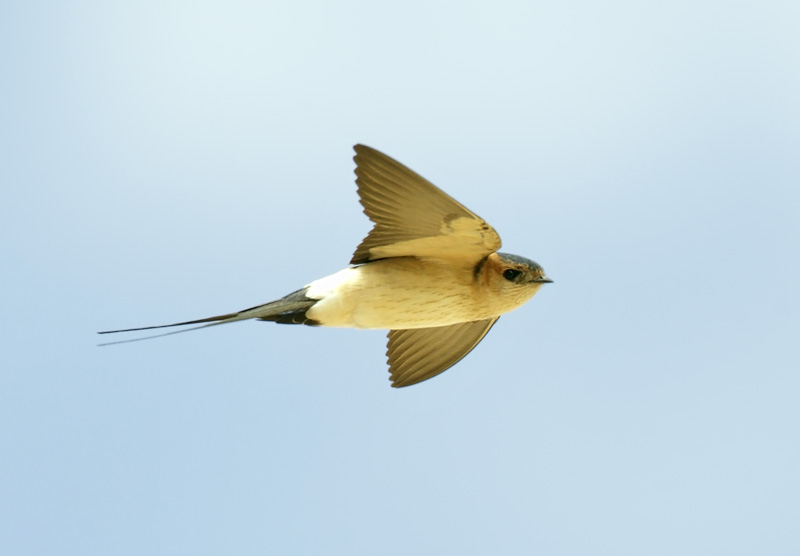
Red-rumped Swallow captured by Canon EOS1D mkIV and Canon 500mm f4.0 , handheld and using all 45 focusing points. Israel, Eilat, March 18th, 2010
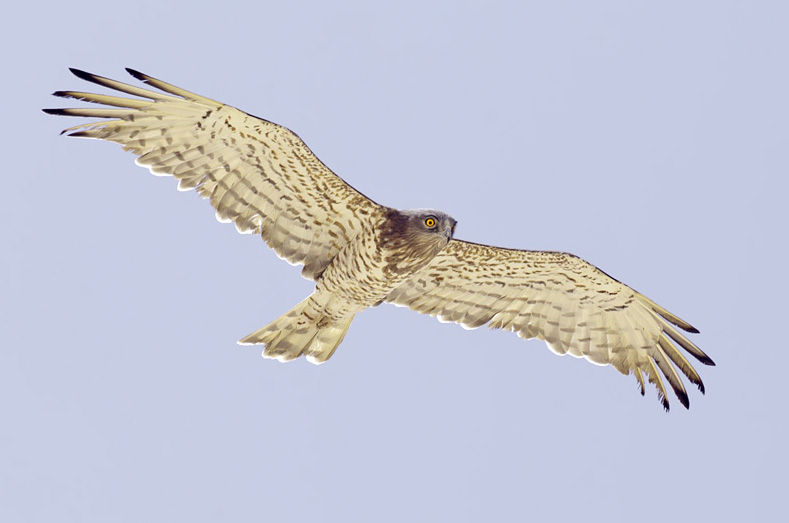
Short-toed Eagle with MarkIV and 500mm Canon using the central focusing point. Situations like this should come out with a 100% success rate, but even clean subjects like this are sometimes not in focus.
About this entry
You’re currently reading “ Shooting birds in flight with Canon EOS1D mkIV -is the autofocus any good? ,” an entry on dickforsman.com
- Published:
- 4.6.10 / 11am
- Category:
- Uncategorized
Comments are closed
Comments are currently closed on this entry.