
RAPTORS IN OMAN, 6. -12. Dec, 2010
A quick dash to Oman to escape the harsh Nordic winter and to improve on some raptor folders in my photo files. And once again, also this trip started with major problems in the beginning, when the connecting flight was delayed by 20 hours, due to the striking air controllers in Spain!
Most of the time in Oman was spent chasing Aquila-eagles in particular, with good shooting sessions on Steppe, Eastern Imperial and Greater Spotted Eagles. In addition to these also Marsh Harriers, Lesser Spotted, Bonelli’s and Booted Eagles, Steppe and Long-legged Buzzards were fired at, but the real surprise and treat of the tour were the Honey Buzzards.
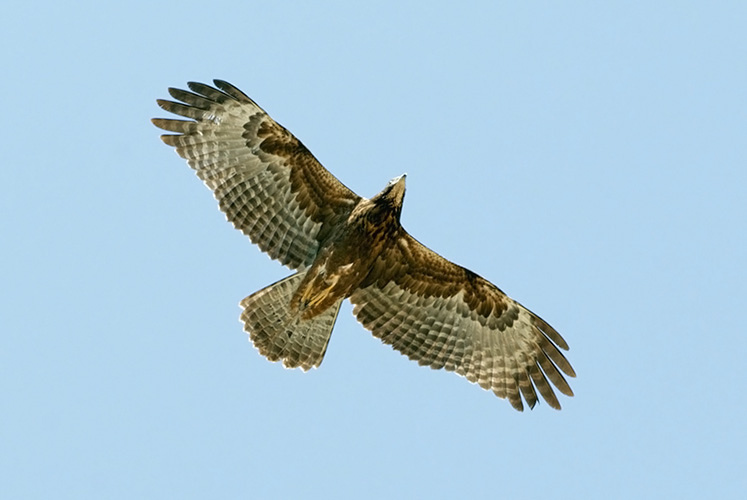
Dark form juvenile Crested Honey Buzzard in Salalah, Oman, Dec 12th,2010
Already from the first morning I realised that Honey Buzzards were around. One of the first birds I saw was a HB gliding away through the trees, but because of the angle there was no chance to id. it specifically. During the following days I saw some, always distant and/or against the light, but from the few shots I managed, I saw that they were all Crested-type (or Oriental) Honey Buzzards. CHB is a rare bird in Oman, and in the “Birdwatching guide to Oman” from 2001 by the Eriksens and Sargeants only four records are accepted, but there has been a few more since then. In this same book Eurasian Honey Buzzard is mentioned as a rare passage migrant and winter visitor to Oman.
Once the eagle-shooting was successfully completed, I decided to spend my last morning looking for the Honey Buzzards trying to get within decent shooting distance. All my records during the week came from the 10 km long green belt of small fields and coconut palms, which straddles the coast at Salalah. This is apparently a very underwatched area, since every birder coming to S Oman tends to follow the directions given in the birding guide, in order to secure the “must-see” birds. I know this from my previous four visits to Oman, as I did not bird in this area once in all those weeks, despite the area’s obvious potential and despite finding a group of six Black-headed Herons there once in Nov 1999.
The honey buzzards are true forest-dwellers, and should therefore be looked for in patches of evergreen forest, such as palm plantations, which they seem to favour, particularly in arid places like the Middle East. The morning turned out to be a great success. By the time I finished at 12:30, I had seen 8 different honey buzzards, 4 of which were Cresteds, 2 apparent hybrids, while two were just glimpses and could not be identified specifically. Out of these I managed to photograph all the Cresteds and the two hybrids. All in all I saw some 15 different honey buzzards during my 6 days in Dhofar, which indicates that, either they have been overlooked in the past, or their numbers have rocketed recently.
About this entry
You’re currently reading “ RAPTORS IN OMAN, 6. -12. Dec, 2010 ,” an entry on dickforsman.com
- Published:
- 12.26.10 / 9pm
- Category:
- Uncategorized
Comments are closed
Comments are currently closed on this entry.