
Probable hybrid spotted eagle at Hanko Bird Observatory, Oct 1st, 2011
Today a probable hybrid Lesser x Greater Spotted Eagle Aquila pomarina x clanga was seen and photographed by myself and several others at Hanko Bird Observatory, S Finland. By large the bird, a 2nd cal yr individual, resembled a GSE, with darker coverts than flight-feathers, and very broad and blunt wings, but the photographs showed several details which did not fully comply with GSE: the barring of flight-feathers is intermediate between the two species; the remiges are darker grey than in GSE; primary p4 (7th finger counting inwards) although a newly moulted feather is very short and rounded; poorly developed white crescent to base of outer primaries, clearly medium brown underwing coverts (colour only discernible in direct sunlight; compare the two images!) when they should be black in GSEs of this age; iris medium brown (should be dark in 2nd cal yr GSE); upperwing contrast as in juv LSE, thus much paler than 2nd cy GSE, but also clearly darker than 2nd cy LSE. Although most of the characters point towards LSE, the very broad and blunt wings, the dark underwing coverts (2nd cy LSE should be pale brown at this stage), the seconadry barring below is finer than in typical LSE and stops well before the tip, as in GSE. Birds of this type could be back-crosses between an F1 hybrid and a LSE, resulting in a bird which is 75% LSE and 25% GSE, but this is of course only a guess.
Hybrids like this are challenging to id. in the field, unless reasonably high quality photographs are taken. Depending on the distance and lighting conditions, and depending on whether the upperparts are seen or not, this individual could easily be identified either as a LSE or as a GSE! Birding was never meant to be easy!
Dick
PS. (added on Oct 4th) This bird was identified as a GSE about half an hour before it appeared at Hanko Bird Observatory. The following day most likely the same bird (cannot be sure!) was identified as a LSE, largely based on the pale and contrasting upperparts! On Sep 17th definitely the same bird was seen and photographed at Kirkkonummi, Porkala, some 3o km SW of Helsinki, and was identified as a GSE (images can be seen at www.tarsiger.com under GSE).
What do we learn from this? Spotted Eagles of today, particularly non-juveniles, are extremely difficult, sometimes impossible, to identify in the field. This is the result from the large-scale interbreeding between the spotted eagle species, which has been well documented e.g. from the Baltic States and Poland. Natural hybrids are in fact common, a painful truth, which we cannot deny any longer. For the identification the importance of good quality photographs cannot be stressed enough.
Dick
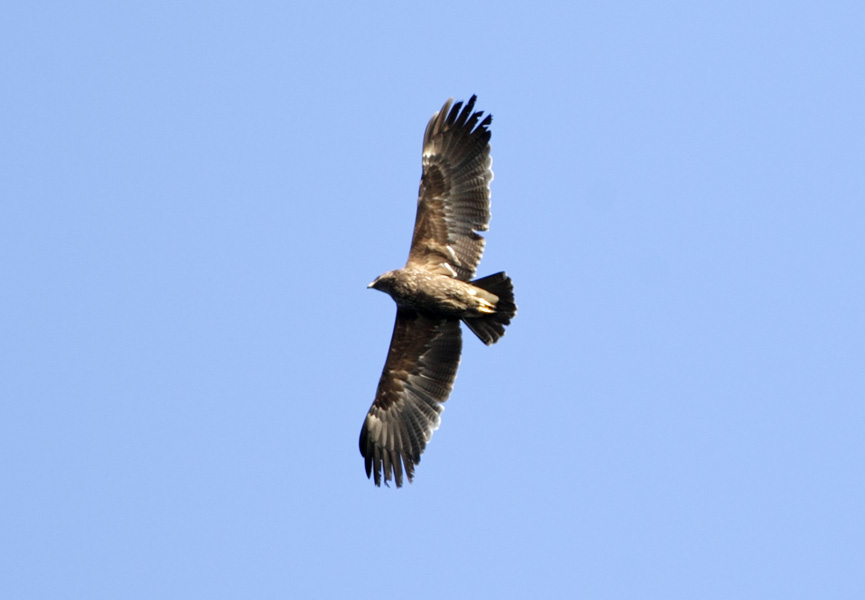
In direct sunlight the underwing coverts were clearly brown with a darker carpal area.
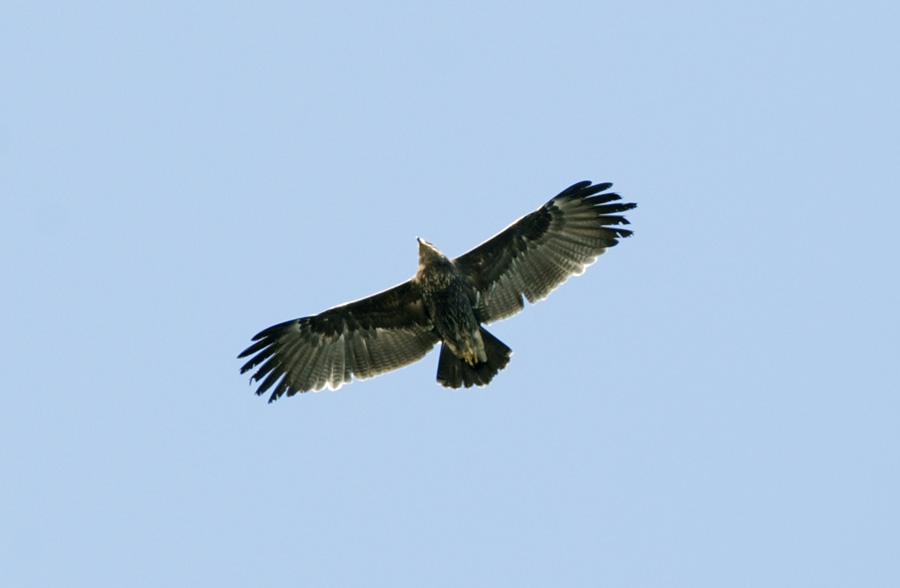
...but most of the time the underwing contrast resembled a normal 2nd cy GSE.
About this entry
You’re currently reading “ Probable hybrid spotted eagle at Hanko Bird Observatory, Oct 1st, 2011 ,” an entry on dickforsman.com
- Published:
- 10.1.11 / 9pm
- Category:
- Uncategorized
Comments are closed
Comments are currently closed on this entry.