
The Gambia over New Year
A short birding break to The Gambia over New Year was a welcome change to the gloomy and wet weather in Finland. Good birding, nice weather and friendly people, that’s Gambia in a nut-shell. Our Finnish-Polish group managed to see some 240 species, which is a rather normal figure for a week of relaxed, coast-only birding. No big surprises this time, still it’s always nice to be back, if only for the genuine African atmosphere.
The event for me took place on Jan 5th, when we birded a wooded area a bit inland from the coast. We had been beating the bush for an hour or so, and were returning to the bus. Suddenly the woman walking behind me on a narrow track gave a loud shriek, and turning around I saw her staring down on the ground muttering “-Snake, snake”. I looked, but could not see anything. Then she said I had trod on it. Only then did my eyes make out the delicate pattern and the shape of a motionless half-grown Puff Adder (Bitis arietans) among the debris of dead leaves and withered grass. The animal looked dead indeed and we started to take pictures, not really knowing whether it was alive or not. After finishing with the photography I took a stick to lift up the snake, which then suddenly became very much alive!
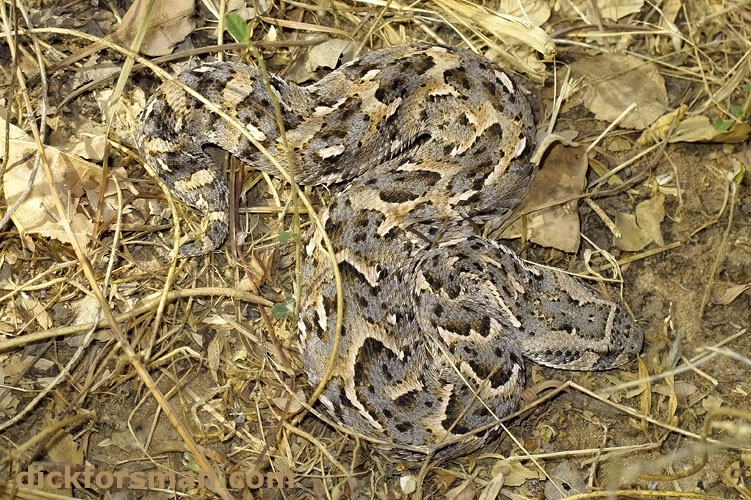
The Puff Adder, here removed from its original position for better photographs.
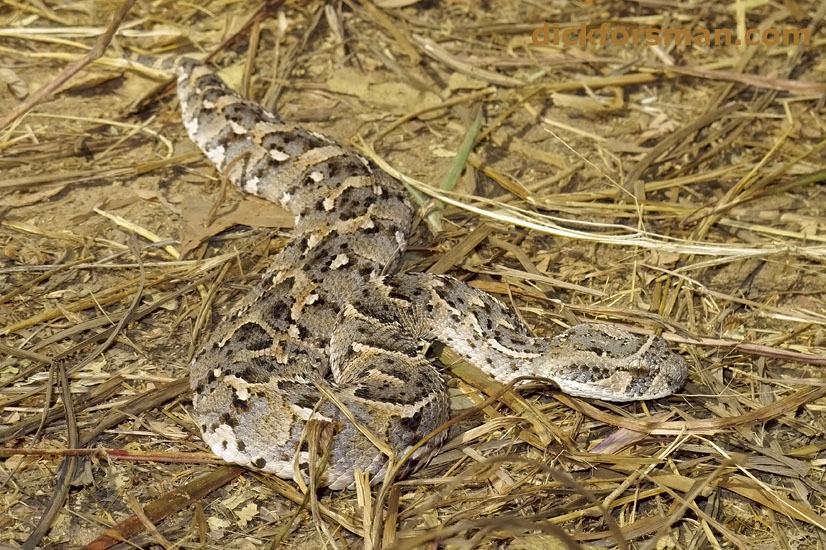
It is the strategy of Puff Adders to remain motionless in situations like this, as they rely completely on their excellent camouflage. However, if you step on it will bite, and Puff Adder is the one snake causing most fatalities of all snakes in Africa! I cannot have trod on it, since there was no strike, but my bare feet (wearing just shorts and open sandals!) cannot have been more than a few centimeters away from the serpent. Realizing how close a shave this was sent cold shivers down the spine, imagining what could have happened.
You don’t see snakes that often, not even in Africa. If you are lucky you glimpse the tip of a tail, when they speed through the grass avoiding closer contact. Two days earlier we had been lucky enough to watch a beautiful Black (Forest?) Cobra, before it eventually slipped into a whole of a termite mound and disappeared. But Puffadders are different. They won’t move, and this is important to remember when walking on trails littered with leaves and dry grass anywhere in Africa. For all the 15 years I have been travelling to Sub-Saharan Africa I always wanted to see a live Puff Adder. I have seen them squashed in the roads a few times before, and once a Black-chested Snake-eagle lifted from a half-eaten monster in Namibia, but this was my first proper sighting, one to remember.
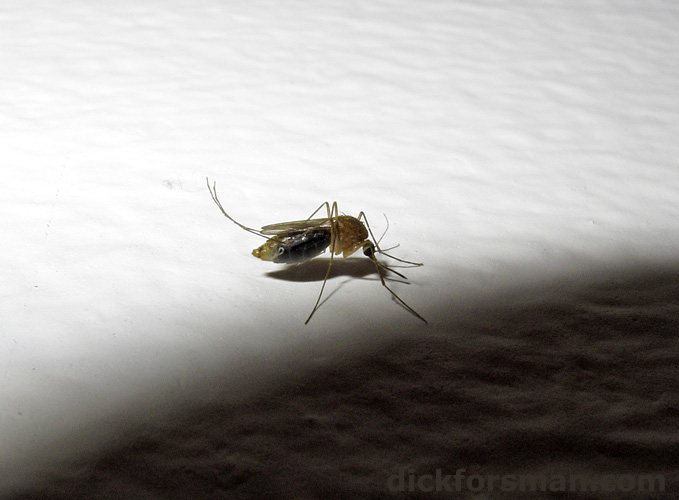
Another African not to forget is the Malaria Mosquito Anopheles sp., here blood-filled and photographed on the wall of my hotel room! Malaria should be taken seriously, and nobody should travel to malaria infested areas without proper prophylactic treatment. I remember reading somewhere, that one mosquito out of 5000 transmits malaria, what about this one?
About this entry
You’re currently reading “ The Gambia over New Year ,” an entry on dickforsman.com
- Published:
- 1.10.12 / 11am
- Category:
- Uncategorized
Comments are closed
Comments are currently closed on this entry.