
SPITSBERGEN-cruise 7-14 July, 2012
I took part in a Spitsbergen cruise as a lecturer on m/s Kristina Katarina, run by Kristina Cruises www.kristinacruises.com from Finland.
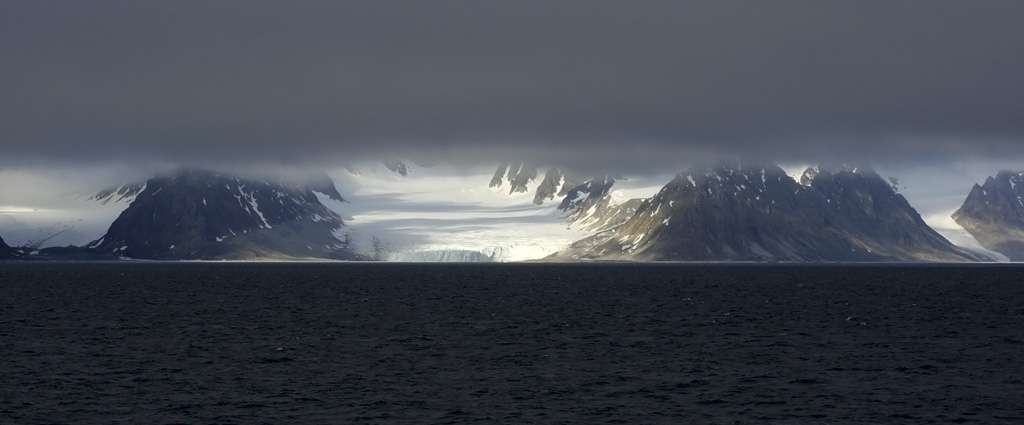
Spitsbergen, Magdalenefjorden, Jul 10, 2012.
day 1. Our flight left Helsinki, Finland at 1 pm, and after a mere two hours we landed in Tromsö, NW Norway, where the weather was nice and sunny. Then, a quick transfer, partly through long tunnels, to the harbour, where our boat was waiting. Birds in the harbour included Great Black-backed, Herring and Common Gulls, Eiders and Oystercatchers. Left Tromsö at 6pm, cruising through dramatic fjord-scapes for a couple of hours, before reaching the open sea. Lots of Puffins around Nord Fuglöya (70o15’N x 20o14’), where there obviously was a big colony.
day 2. All day at sea heading north in rather strong headwinds and pretty rough seas. Plenty of free space in the restaurant at breakfast! Not much happening, until at about 1500 hrs, when birds started to gather around the boat. Fulmars, Kittiwakes and Glaucous Gulls were following the boat, while groups of guillemots (Common and Brünnich’s) were crossing our path low over the sea. The reason for the sudden occurrence of birds was clear, we were approaching the waters of Bear Island (Björnöya), the home of hundreds of thousands of seabirds. The island was still some 60 nautical miles (ca. 110 kms) away, but this just shows how far these birds will fly on their daily foraging trips. As we passed the southern tip of the island (74o20’N x 18o46’E) also some Great Skuas were seen, one of them hammering the life out of an unfortunate Kittiwake.
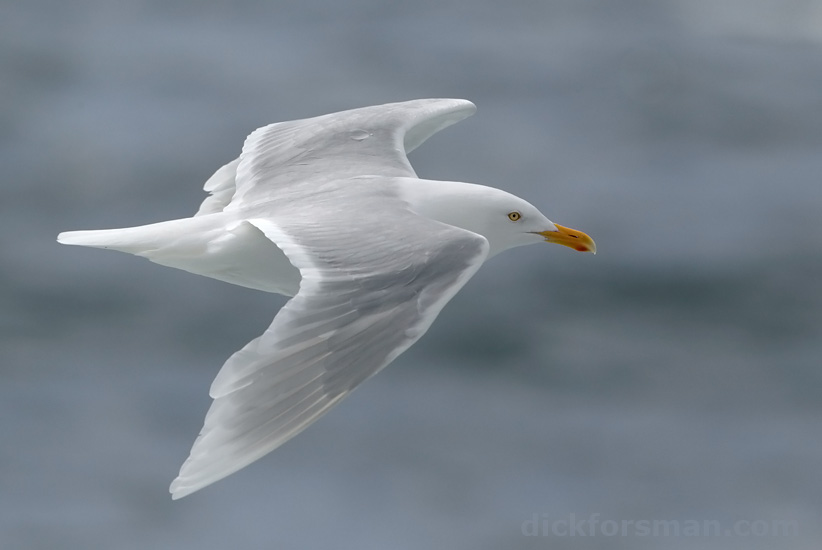
Adult Glaucous Gull Larus hyperboreus. Off Bear Island, Jul 8th, 2012
day 3. Early morning saw the silhouette of Prins Karls Forland in the east (position 78o10’N x 11o13’E), a long island straddling the western coast of the main island of Spitsbergen. Clouds were hanging low and the temperature was just a few degrees above freezing. Fulmars were still escorting the boat, but now all of them were of the darker, grey morph (“Blue Fulmar”), while around Bear Island the common white-headed form comprised about 50% of the birds. A new feature was the appearance of Little Auks, scurrying in small groups tightly above the sea, heading for their offshore fishing grounds.
Arrived at Ny-Ålesund at 1520hrs. Before the boat had even docked we spotted two adult Ivory Gulls by the pier! This was my most wanted bird on this trip, and I couldn’t believe our luck as these two white angels fluttered around our ship for everyone to see.
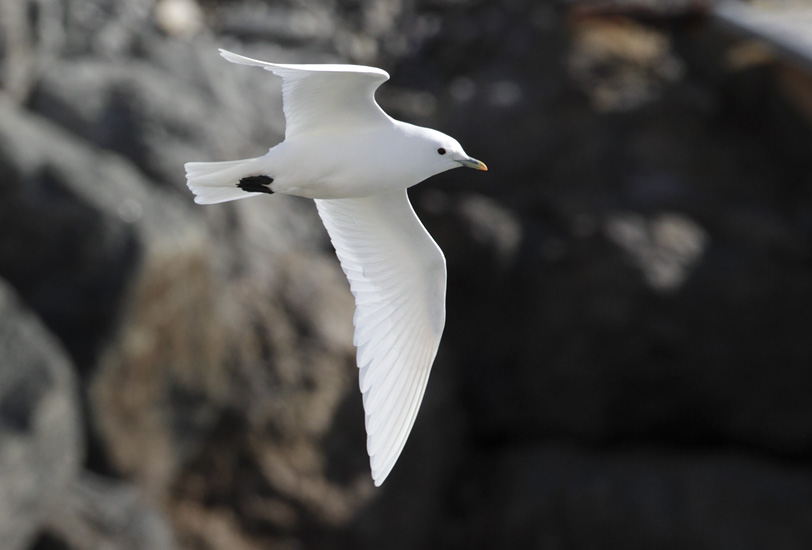
Adult Ivory Gull Pagophila eburnea flying around our boat in Ny-Ålesund harbour, Jul 9th, 2012.
Ny-Ålesund is a small community of mostly researchers, with many restrictions as to where you can walk and what you are allowed to do. Basically, one is supposed to keep to the roads and tracks, which of course was a bit annoying to a birder. Still, even with all the restrictions the birding was good: in the pond just by the port a Red-throated Diver was incubating, while Common Eiders already had their newly hatched chicks on the water. There were also several Purple Sandpipers busily feeding along the shoreline, while Snow Buntings were busy carrying insects to their fledglings and nesting Arctic Terns were dotted everywhere. A pair of Long-tailed Ducks accompanied the Eiders in the pool and a single Red (or Grey) Phalarope in stunning red plumage but a bit distant, put in an appearance as well.
The main target was, however, the Ivory Gulls, which had disappeared meanwhile, but we managed to find one of them near a small Husky farm, a kilometre or so inland. A stunning white bird with a blue and orange-tipped bill (never realised the bill was so colourful)! Our best find in Ny-Ålesund was, however, a Pectoral Sandpiper, which was feeding in a boggy area not far from the Husky farm. There are some previous records of the species from Svalbard and we managed to get some decent images to prove our case.
Left Ny-Ålesund at 1900 hrs., steering towards the edge of the pack-ice, which we were supposed to reach the following morning.
day 4. The morning was grey and definitely fresh, with low clouds and rather still, and a temp. of +2oC. As we approached the ice, I was surprised by the rich birdlife this far from the nearest land: Brünnich’s and Black Guillemots, Little Auks, Fulmars and Kittiwakes were all here. We also saw several groups of Harp Seals among the ice and a possible Ringed Seal resting in the middle of a huge ice floe. The furthest spot we reached was at 80o20’N x 06o05’E, but there we had to turn around. As the ship was drifting at this northernmost point of our journey two Ivory Gulls flew past, but no signs of the hoped for Polar Bear despite very hard looking!
After sailing a few hours in a south-easterly direction we arrived at the mouth of Magdalenefjord in the NW corner of Spitsbergen, our next destination. Approaching the fjord we saw two groups of Walruses on the water, not far from the boat. Little Auks and guillemots were around in thousands, with big flocks swirling like insects around the tallest mountain peaks, still covered in snow. Also the odd whales had been seen, both Humpbacks and possible Minke Whales.
Went ashore on Graveneset, a burial ground for whalers dating back to the 17th century. The beach was excellent for a swim, and more than 40 (!) cruise guests went for a refreshing swim (water temp +1oC!). The birdlife consisted of some pairs of Barnacle Geese and Glaucous Gulls, and of course the inevitable Arctic Terns.
Sailed off at 1900 hrs heading towards Longyearbyen, where we should arrive next day.
day 5. Early morning found us already at the wide mouth of Isfjorden as we steamed east towards our first destination, the glaciers of Billefjord (78o 40’N x 16o 50’E). We passed several settlements dating back to the glory days of coal mining in Spitsbergen, including Longyearbyen, but the most impressive monument was the Russian ghost-town of Pyramiden, on the N side of the fjord, which was permanently abandoned in 1998.
Entering Billefjord we had a nice Bearded Seal on an ice floe very close to the boat, while birds consisted of the normal Fulmars and guillemots.
After Billefjord our next stop was Longyearbyen (78o14’N x 15o31’E), where we had 6 hours to spend. My personal target here was the Red Phalarope, which usually are to be found in the vicinity of the town. The few kilometres of walking from the port towards Adventdalen was nice birding all the way. There was a good scattering of Common Eiders, Glaucous Gulls, Barnacle Geese, Purple Sandpipers and Snow Buntings, while a pair of Arctic Skuas, some Dunlins and yet another adult Ivory Gull stood for quality. Eventually we also found the Phalaropes, one female and two males, which gave good views down to a few metres.
Left Longyearbyen at 1900 hrs, starting our nearly two-day long journey back towards Tromsö.
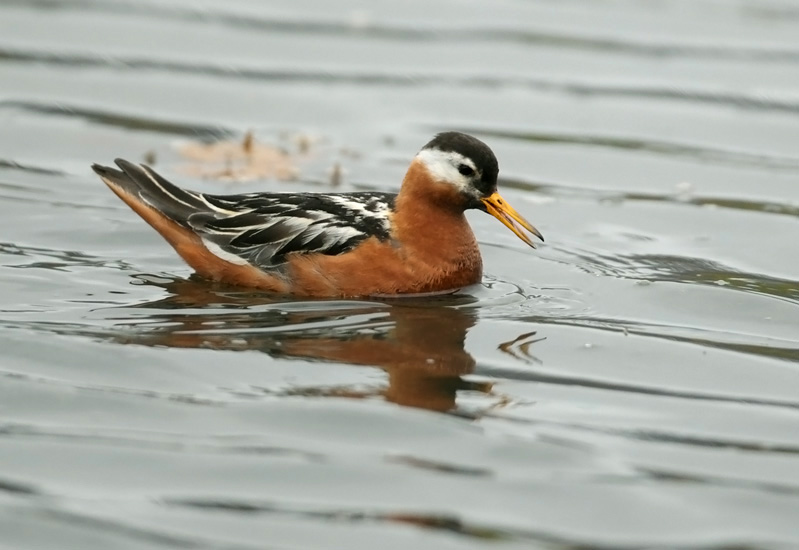
Female Red (Grey) Phalarope Phalaropus fulicarius. Longyearbyen, Jul 11th, 2012.
day 6. All day at sea. We passed Bear Island in the afternoon with nice Fulmars, Glaucous Gulls and Kittiwakes following the boat while thousands of guillemots crossed our path on their way out to sea. Again, approximately half of the Fulmars seen were of the southerly white morph. More auks now, than on the way up, with big flocks flying back and forth between the island and the fishing grounds further out at sea.
day 7. No more Fulmars as we approached the Norwegian coast! Instead we had beautiful and sunny weather, with the +19o C by the coast feeling almost tropical.
By Nord Fuglöya-island a group of 6 White-tailed Eagles caught our eyes, as they were playing in the wind around the peaks. Of interest were also 2 adult intermedius Lesser Black-backed Gulls which, with their slim and long-winged proportions and jet-black upperparts appeared identical to the Finnish and Swedish nominate subspecies fuscus, the Baltic Gull, which we are familiar with from home. Arrived at Tromsö harbour at 1500 hrs.
day 8. All day at Tromsö, where the weather was grey and wet. Spent the day on the boat working on the laptop. Our evening flight back to Helsinki left on time, taking us to darker nights and shorter days. Another arctic experience was over.
About this entry
You’re currently reading “ SPITSBERGEN-cruise 7-14 July, 2012 ,” an entry on dickforsman.com
- Published:
- 7.16.12 / 1pm
- Category:
- Uncategorized
Comments are closed
Comments are currently closed on this entry.